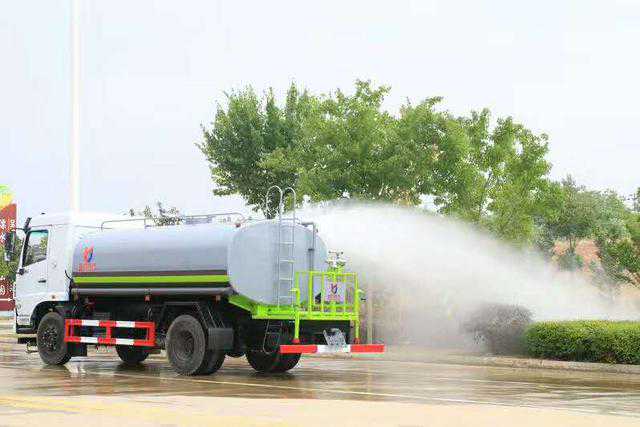
Why does the export sprinkler truck often have “no pressure at all”?
1.1 Typical fault phenomenon: the truck has no pressure at all
Many drivers describe the same problem: the water pump is running, but no water comes out and the sprinkler truck has no pressure at all.
At this moment, everyone mainly wants to know two things: where exactly did it go wrong, and from which step should you start checking the pressure on the water truck?
1.2 The most common scenarios in remote video after‑sales service
In actual export after‑sales work, drivers often call us on video and say, “There is no pressure at all now.”
When we look around the truck remotely, we often find that several valves are in the wrong position. After we guide them to adjust the four‑position three‑way ball valve and the straight‑through ball valve to the correct direction, normal water spraying is restored within 30 seconds.
From water pump to valves: 6‑step troubleshooting process when the export sprinkler truck has no pressure
2.1 Listen for abnormal noise in the water pump and check if the water seal is leaking
The first step is to use your ears and eyes to judge the condition of the pump itself, without any tools.
Listen carefully for any abnormal noise inside the sprinkler pump, and then check whether the water seal is leaking.
If there is obvious abnormal noise, in about 80% of cases you can judge that the impeller is damaged. If the water seal is leaking, it will also directly affect pump pressure. In both situations, you should stop operation immediately.
2.2 Clean the filter screen and eliminate foreign matter blockage
If the pump sounds normal and the water seal is not leaking, you can temporarily rule out the pump body and move on.
First, check the filter screen. Remove it and clean it thoroughly.
The key is to see whether any foreign matter is blocking the filter screen. If you find sediment or debris, remove it completely. Many low‑pressure or “no pressure” problems on export water trucks can be solved at this stage.
2.3 Check the direction of the four‑position three‑way ball valve and the straight‑through ball valve
If the filter is clean, the next step is to check valve direction.
Confirm whether the four‑position three‑way ball valve handle is in the correct position, and check whether the straight‑through ball valve is opened or closed properly.
This point is critical. In many remote video after‑sales cases with “no pressure at all”, the real reason is simply that the valve direction is wrong. After we help the driver adjust the valves correctly, the problem is often solved in about 30 seconds.
2.4 Check whether the tank outlet is blocked
After you confirm that the valve direction is correct, you need to check whether the water supply from the tank is smooth.
Focus on the water outlet inside the tank and see if anything is blocking it.
If the tank outlet is blocked, the water supply will be insufficient. Even if the driver increases the throttle, he will not feel any increase in pressure at the nozzles.
2.5 Confirm whether the ball valves are aging and whether the inner core rotates with the handle
If all of the above steps are normal, then you should suspect the ball valves themselves.
There is a very hidden situation: after long‑term use, some ball valves age. On the outside, the handle appears to rotate normally, but the valve core inside does not rotate with it.
In this case, it is as if the ball valve does not exist. If the waterway is not truly opened or closed inside, it is impossible to build normal pressure in the system.
2.6 Distinguish between left‑hand and right‑hand pumps and check installation direction
Finally, come back to the installation of the sprinkler pump itself.
Before installing the pump, it is very important to distinguish clearly whether it is a left‑hand pump or a right‑hand pump.
If a left‑hand sprinkler pump and a right‑hand sprinkler pump are installed in reverse, there may be no pressure or only very low pressure. This kind of problem cannot be judged by appearance with the naked eye. You must confirm the rotation direction clearly before installation on any export water truck.
After 6 steps: review of common reasons for no pressure on export sprinkler trucks
3.1 Pump body failures: impeller and water seal
From the steps above, you can see that the first category of problems is focused on the pump body.
As soon as you hear obvious abnormal noise and see the water seal leaking, you can basically judge that the impeller or other core components of the pump are faulty. At this stage, if you continue to run the sprinkler truck, the problem will only get worse.
3.2 Operation issues: valve direction and water supply blockage
The second category of problems is more related to operation.
Many “no pressure at all” cases finally turn out to be the wrong direction of the four‑position three‑way ball valve or the straight‑through ball valve, or foreign matter blocking the filter screen and the tank outlet.
These problems are not complicated in themselves, but if you do not check them in order, it is very easy to mistake them for serious mechanical failures.
3.3 Hidden issues: aging ball valves and incorrect pump rotation direction
The third category is relatively hidden.
One reason is aging ball valves: the external handle rotates smoothly, but the internal valve core does not move at all. The other reason is that the left‑hand and right‑hand rotation of the sprinkler pump is reversed, which causes the whole system to have no pressure.
These two conditions are almost invisible from the outside and are easily overlooked, but their impact on water pressure is direct and obvious.
How overseas drivers and dealers can make good use of this 6‑step checklist
4.1 If there is no pressure, first follow the 6 steps for self‑inspection
In future when an export sprinkler truck has no pressure, we suggest not immediately blaming all the accessories or changing parts blindly.
Follow this 6‑step checklist in sequence: from abnormal water pump noise and water seal leakage, to the filter screen, valves, tank outlet, ball valve aging, and pump rotation direction.
For overseas drivers, this inspection process is simple and intuitive. For water truck export suppliers, it is also convenient to forward this checklist directly to end users as a standard guide.
4.2 After completing the 6 basic checks, then consider more complex faults
Only after you confirm that all six basic points are correct should you consider deeper and more complex faults. This will save a lot of time.
In this way, you can reduce misjudgment and avoid replacing unnecessary parts, and at the same time provide a unified communication template for customized sprinkler truck manufacturers during remote after‑sales service.
Quick reference: water truck / sprinkler truck has no pressure – 6‑point self‑inspection checklist
Check the sprinkler pump
Listen for any abnormal noise inside the sprinkler pump, and check whether the water seal is leaking.
If there is abnormal noise, in about 80% of cases you can judge that the impeller is damaged. If the water seal leaks, it will also affect pump pressure. In both cases, stop using the truck immediately.Check and clean the filter screen
Remove and clean the filter screen, and check whether any foreign matter is blocking it.
If there are foreign objects, remove them completely, reinstall the filter, and then try to build pressure again.Check the four‑position three‑way ball valve and the straight‑through ball valve
Confirm whether the position of the four‑position three‑way ball valve handle is correct, and whether the straight‑through ball valve is opened or closed as needed.
Wrong valve direction is a direct and common cause of on‑site situations where there is no pressure at all.Check the water outlet inside the tank
Check whether anything is blocking the water outlet inside the tank.
Once the outlet is blocked and the water supply is insufficient, no matter how much throttle you apply, the pressure at the nozzles will not increase.Check whether all ball valves are aging
Observe whether the inner core of each ball valve rotates together with the handle when you turn it.
If the handle turns but the inner core does not move, it means the ball valve has aged and is not functioning. It needs to be carefully checked or replaced.Confirm the installation direction of the sprinkler pump
Before installation, distinguish clearly whether the pump is a left‑hand pump or a right‑hand pump.
If a left‑hand and a right‑hand sprinkler pump are installed in reverse, there will be problems with no pressure or very low pressure in the whole system.
If you have checked all six points and your export water truck still has no pressure, the next step is to record a short, clear video showing the pump, main valves, and tank outlet, and send it to your supplier’s after‑sales team. This 6‑step checklist plus a simple video will greatly speed up remote troubleshooting for overseas drivers and dealers.